
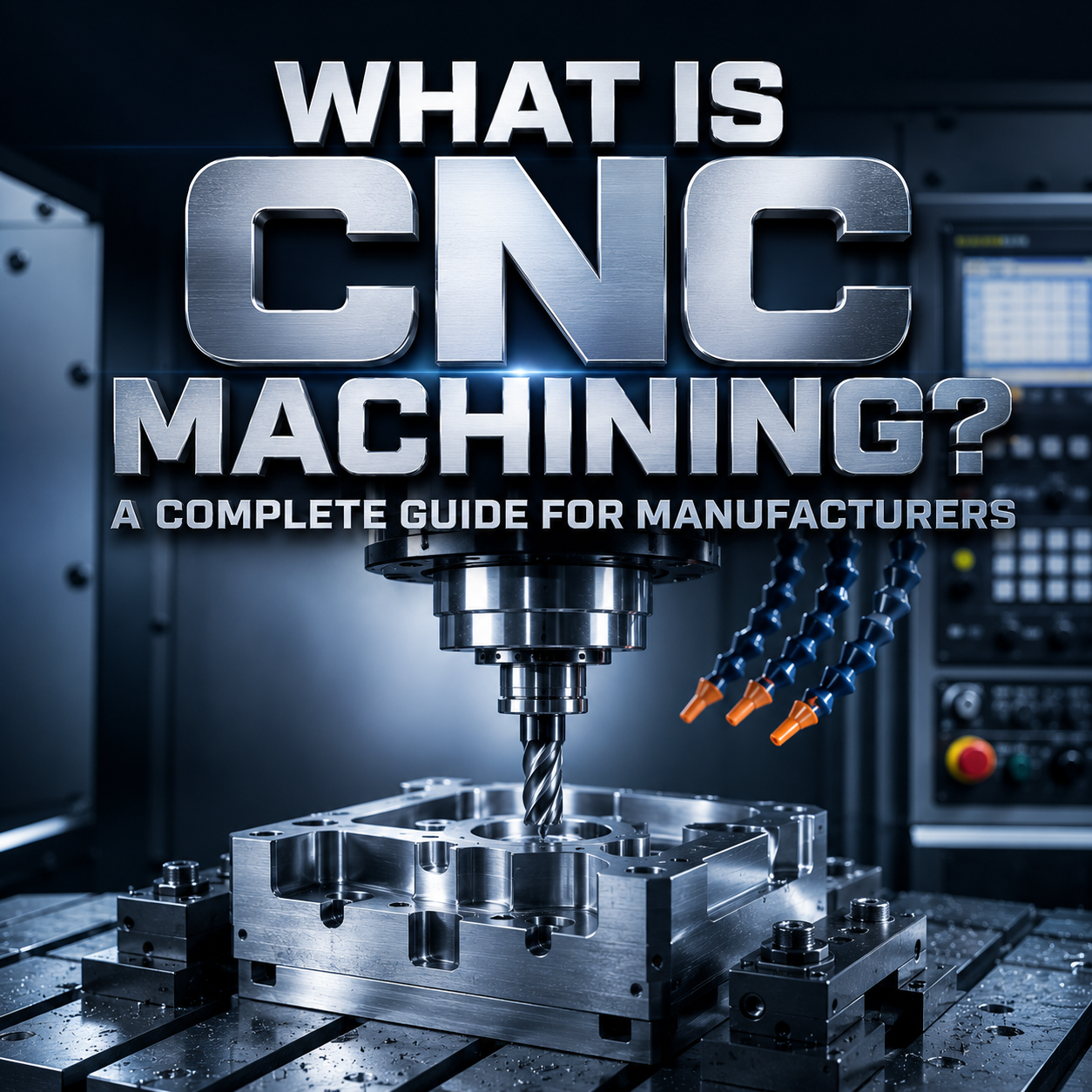
Introduction
In today's competitive manufacturing industry, precision, speed, and consistency are essential for producing high-quality components. One technology that has transformed modern manufacturing is CNC machining. From automotive and aerospace to medical equipment and industrial tooling, CNC machines are widely used to manufacture complex parts with exceptional accuracy.
Whether you're new to CNC manufacturing or looking to improve your production process, understanding how CNC machining works can help you make better decisions for your business. This guide explains the CNC machining process, its benefits, applications, and why selecting the right material is just as important as choosing the right machine.
What Is CNC Machining?
CNC (Computer Numerical Control) machining is an advanced manufacturing process in which computer-controlled machines remove material from a workpiece to produce highly accurate parts.
Unlike conventional machining, CNC machines operate using programmed instructions, allowing manufacturers to produce identical components repeatedly with minimal human intervention.
Common materials used in CNC machining include:
- Tool Steel
- Stainless Steel
- Mild Steel
- Aluminium
- Brass
- Copper
- Titanium
- Engineering Plastics
How CNC Machining Works
The CNC machining process follows a series of automated steps that ensure precision and consistency.
Step 1: Design Creation
Engineers create a 2D or 3D model using CAD (Computer-Aided Design) software.
Step 2: CAM Programming
The CAD design is converted into machine-readable instructions using CAM (Computer-Aided Manufacturing) software.
Step 3: Machine Setup
The workpiece is securely clamped, and the required cutting tools are installed in the CNC machine.
Step 4: Machining Process
The CNC controller directs the machine to perform operations such as milling, drilling, turning, boring, and tapping according to the programmed tool path.
Step 5: Quality Inspection
After machining, the finished component is inspected to ensure it meets dimensional and quality requirements.
Main Types of CNC Machines
Different CNC machines are designed for specific manufacturing applications.
CNC Milling Machine
Used for cutting, slotting, drilling, contouring, and creating complex shapes.
CNC Turning Machine
Ideal for producing cylindrical components by rotating the workpiece while the cutting tool removes material.
CNC VMC (Vertical Machining Center)
A widely used machine where the spindle is vertically mounted, offering high precision for moulds, dies, and engineering components.
CNC Horizontal Machining Center (HMC)
Suitable for heavy-duty machining and large production runs with improved chip evacuation.
5-Axis CNC Machine
Capable of machining complex geometries in a single setup, making it ideal for aerospace, medical, and precision engineering applications.
Common CNC Machining Operations
CNC machines can perform multiple machining operations on a single workpiece.
These include:
- Milling
- Turning
- Drilling
- Boring
- Reaming
- Tapping
- Thread Milling
- Surface Profiling
- Engraving
Combining these operations in one setup reduces production time and improves accuracy.
Advantages of CNC Machining
CNC machining offers several advantages that make it the preferred choice for modern manufacturers.
- High precision and accuracy
- Excellent repeatability
- Faster production cycles
- Reduced human error
- Capability to machine complex parts
- Better surface finish
- Lower material wastage
- Increased productivity
- Consistent product quality
- Suitable for both prototype and mass production
Industries That Use CNC Machining
CNC machining is widely used across numerous industries because of its versatility and precision.
Some major industries include:
- Automotive
- Aerospace
- Tool and Die Manufacturing
- Plastic Mould Manufacturing
- Medical Equipment
- Electronics
- Oil and Gas
- Defence
- Heavy Engineering
- Industrial Machinery
Choosing the Right Material for CNC Machining
The performance of CNC machining depends not only on the machine but also on the quality of the material being machined.
When selecting materials, manufacturers should consider:
- Machinability
- Hardness
- Wear resistance
- Toughness
- Heat resistance
- Dimensional stability
- Surface finish requirements
- Production volume
Choosing the right material helps improve machining efficiency while extending cutting tool life.
Conclusion
CNC machining has become the backbone of modern manufacturing by delivering unmatched precision, consistency, and efficiency. Whether producing simple components or highly complex parts, CNC technology enables manufacturers to improve productivity while maintaining exceptional quality standards.
However, even the most advanced CNC machine performs best when paired with high-quality materials. Selecting premium tool steel not only enhances machining performance but also extends tool life, reduces maintenance, and improves overall manufacturing efficiency. By combining advanced CNC technology with reliable industrial-grade steel, manufacturers can consistently achieve superior results and long-term operational success.