
Introduction
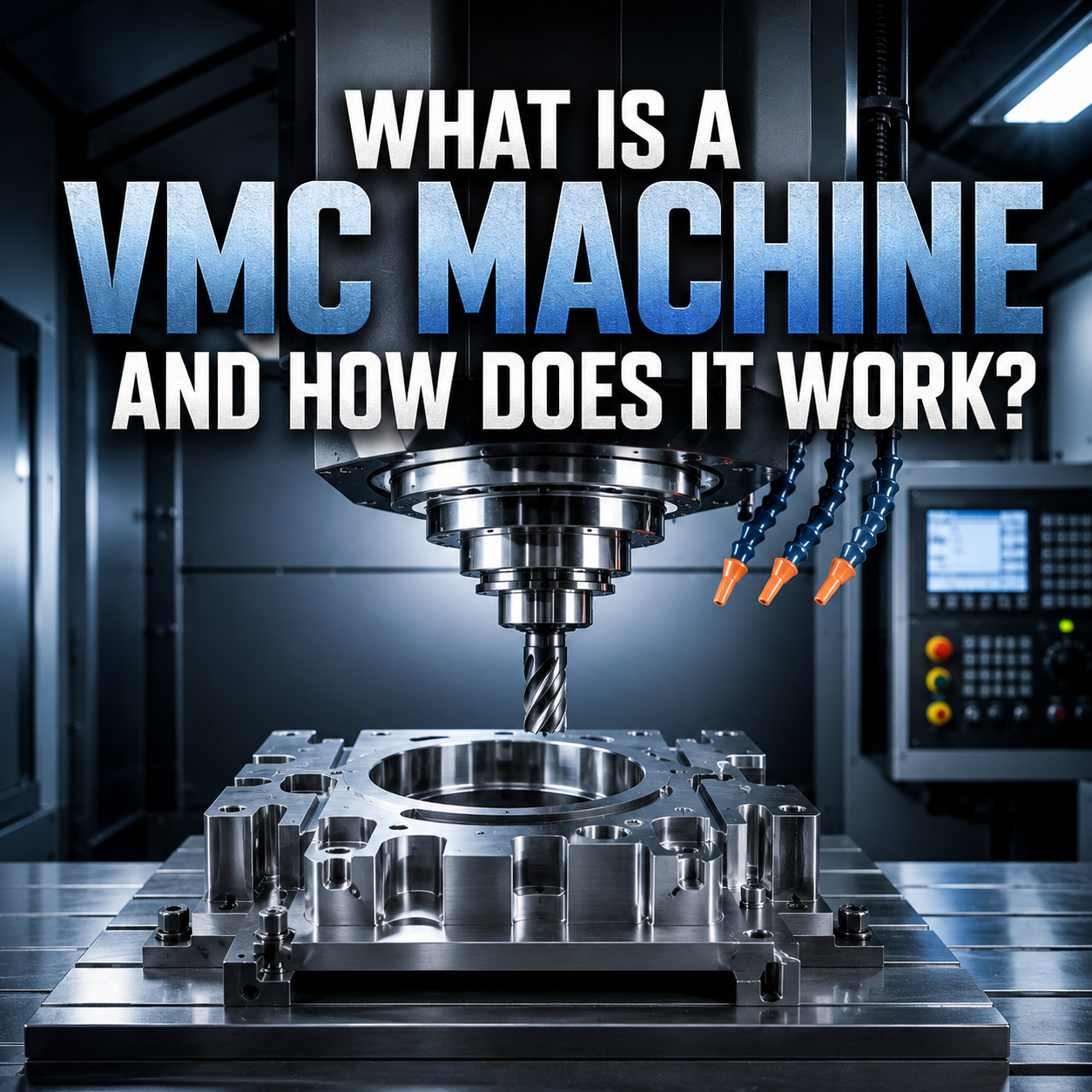
Modern manufacturing demands high precision, faster production, and consistent quality. One of the most widely used machines that helps industries achieve these goals is the VMC machine, also known as a vertical machining center From automotive parts to aerospace components and industrial moulds, VMC machines play a crucial role in precision machining.
In this guide, we'll explain what a VMC machine is, how it works, its major components, advantages, and why selecting the right material is equally important for achieving the best machining results.
What Is a VMC Machine?
A Vertical Machining Center (VMC) is a CNC (Computer Numerical Control) machine where the spindle is positioned vertically. It is designed to perform multiple machining operations such as:
- Milling
- Drilling
- Boring
- Tapping
- Slotting
- Surface finishing
The machine follows programmed instructions, allowing it to produce highly accurate components with minimal manual intervention.
VMC machines are widely used because they combine speed, precision, and repeatability, making them ideal for both small-batch and mass production.
Main Components of a VMC Machine
A VMC machine consists of several important parts that work together to perform machining operations.
Machine Bed
The machine bed provides a rigid foundation that minimizes vibration during machining.
Spindle
The spindle holds and rotates the cutting tool at high speeds for accurate material removal.
Work Table
The workpiece is securely clamped on the table, which moves along different axes during machining.
Automatic Tool Changer (ATC)
The ATC automatically changes cutting tools, reducing downtime and improving productivity.
CNC Controller
The CNC controller reads programmed instructions and controls every movement of the machine with high accuracy.
Coolant System
The coolant system reduces heat generation, improves tool life, and provides a better surface finish.
How Does a VMC Machine Work?
A VMC machine operates using CNC programming that controls every movement of the cutting tool.
The working process generally follows these steps:
Step 1: The workpiece is fixed securely on the machine table.
Step 2: A CAD/CAM-generated CNC program is loaded into the controller.
Step 3: The spindle rotates the selected cutting tool at the required speed.
Step 4: The machine automatically moves along the X, Y, and Z axes to remove material according to the programmed path.
Step 5: If multiple operations are required, the Automatic Tool Changer replaces tools without manual intervention.
Step 6: After machining is complete, the finished component is inspected for dimensional accuracy and surface quality.
This automated process enables manufacturers to produce complex parts with excellent precision and consistency.
Advantages of Using a VMC Machine
VMC machines offer several advantages across different manufacturing industries.
- High machining accuracy
- Faster production cycles
- Excellent repeatability
- Reduced manual errors
- Better surface finish
- Automatic tool changing
- Capability to machine complex components
- Lower production costs in large-scale manufacturing
- Improved productivity and efficiency
Common Industrial Applications
VMC machines are widely used across numerous industries for manufacturing precision components.
Some common applications include:
- Automotive components
- Plastic mould manufacturing
- Tool and die making
- Aerospace components
- Medical equipment
- Engineering industries
- Electronics manufacturing
- Industrial machinery parts
- Precision fixtures and jigs
Factors to Consider Before Choosing a VMC Machine
Selecting the right VMC machine depends on your production requirements.
Consider the following factors:
- Machine size and table capacity
- Number of machining axes
- Spindle speed and power
- Tool magazine capacity
- CNC controller features
- Required machining accuracy
- Production volume
- Maintenance and service support
Choosing the correct machine improves productivity and reduces operational costs over time.
Why Material Selection Matters in VMC Machining
Even the most advanced VMC machine cannot deliver optimal results if the material quality is poor.
High-quality tool steel grades offer:
- Better machinability
- Longer tool life
- Improved dimensional stability
- Reduced machining defects
- Higher production efficiency
- Superior finished surface quality
For industries involved in mould making, die manufacturing, and precision engineering, selecting premium-grade tool steel is just as important as choosing the right machining equipment.
Conclusion
A VMC machine has become one of the most essential manufacturing solutions for industries requiring precision, speed, and efficiency. Its ability to perform multiple machining operations with minimal human intervention makes it indispensable in modern production environments.
However, achieving the best machining performance depends not only on the machine itself but also on using the right materials. High-quality tool steel helps improve machining accuracy, extend tool life, and enhance overall productivity. By combining advanced VMC technology with premium industrial steel, manufacturers can consistently produce reliable, high-quality components while reducing downtime and operational costs.