
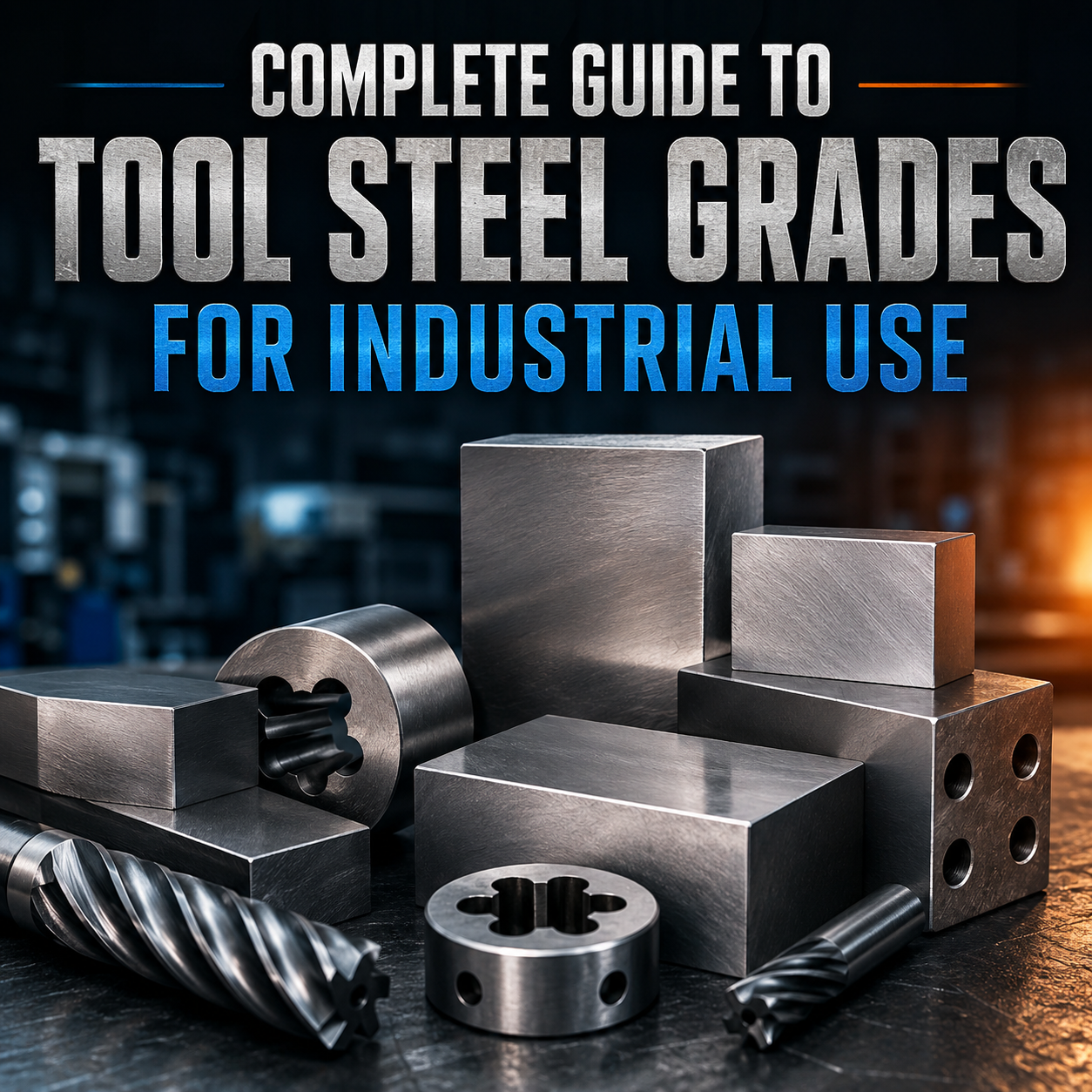
Tool steel grades are special types of steel designed for making tools, dies, moulds, cutters, and industrial components. These steels are known for their high hardness, excellent wear resistance, strength, and ability to withstand heat during heavy industrial operations.
Different industries use different tool steel grades depending on the application. Choosing the correct tool steel grade is important for improving tool life, machining performance, and production efficiency. In this guide, we will explain different tool steel grades, their properties, applications, and how to choose the right grade for industrial use.
What is Tool Steel?
Tool steel is a carbon and alloy steel specially developed for manufacturing industrial tools. It contains elements such as:
- Tungsten
- Molybdenum
- Chromium
- Vanadium
- Cobalt
These alloying elements improve:
- Hardness
- Toughness
- Heat resistance
- Wear resistance
- Machinability
Main Types of Tool Steel Grades
Tool steel grades are classified based on their composition, hardness, heat resistance, toughness, and industrial applications. Each type is designed for specific manufacturing and machining operations.
Below are the main types of tool steel grades explained in simple language.
Cold work tool steels are used for applications where cutting and shaping are done at room temperature. These steels offer excellent wear resistance and dimensional stability.
Common Grades
- D Series: D2 Tool Steel
- A Series: A2 Tool Steel
- O Series: O1 Tool Steel
Key Features of Cold Work Steel
- High wear resistance
- Good toughness
- Excellent hardness
- Better dimensional stability
Applications
Cold work steel is employed across a variety of industrial sectors due to its versatility. Here are some of its most common applications:
- Tool and die making
- Blanking and Shearing tools
- Punches and Cutting tools
- Cold forming tools
- Thread rolling dies
2. Hot Work Tool Steel
Hot work tool steels are specially designed to work under high temperatures without losing hardness. In simple language, we can say hot work tool steel is specifically engineered to operate in high-temperature environments, generally above 200°C.
Common Grades
- H11 Tool Steel(W.NR. 1.2343)
- H13 Tool Steel(W.NR. 1.2344): H13 is one of the most widely used hot work tool steels.
- H21 Tool Steel(W.NR. 1.2581)
Key Features of Hot Work Steel
- Excellent heat resistance
- Good thermal fatigue strength
- High toughness
- Resistance to cracking
Applications
- Die casting dies
- Forging dies
- Extrusion tools
- Hot punches
3. High Speed Steel (HSS)
High Speed Steel is designed for high-speed cutting operations. It can maintain hardness even at elevated temperatures. High Speed Steel (HSS) is one of the most widely used materials in the manufacturing and tooling industry.
Common HSS Grades
High Speed Steel is mainly divided into three grades:
- M2 Steel or W.NR. 1.3343: General-purpose HSS
- M35 Steel or W.NR. 1.3243: Contains cobalt for better heat resistance
- M42 Steel or W.NR. 1.3247: High cobalt content for extreme performance
Key Features of HSS
- Excellent cutting performance
- High red hardness
- Superior wear resistance
- Long service life
Applications
Known for its exceptional hardness, wear resistance, and ability to withstand high temperatures, HSS plays a crucial role in modern machining and industrial applications.
- Milling cutters, Drill bits, Reamers, Taps and dies
- Aerospace Industry: Precision components and High-performance tooling
- Machining Operations: CNC machining, Turning operations, Precision cutting
Grade Comparison
Grade | Main Advantage | Typical Use |
M2 | General-purpose HSS | Standard cutting tools |
M35 | Contains cobalt | Stainless steel machining |
M42 | Very high hardness | Heavy-duty machining |
4. Plastic Mould Tool Steel (P Grade)
Plastic mould steels are specially developed for making plastic injection molds and dies. These steels are specifically designed to withstand the repetitive stress of moulding operations while maintaining the precision required for high-quality production.
Common Grades
- P20 Tool Steel or DIN 1.2311 or W.NR. 1.2311
- W.NR. 1.2738 – Improved toughness and uniform hardness, ideal for large moulds
- W.NR. 1.2312, W.NR. 1.2738, W.NR. 1.2738HH, W.NR. 1.2083, W.NR. 1.2083ESR, W.NR. 1.2085, W.NR. 1.2316, W.NR. 1.2316HH
Key Features of Plastic Mould Steel
- Good machinability
- Excellent polishability
- Uniform hardness
- Good surface finish
Applications
Unlike regular steel, mould steel is engineered to handle pressure, heat, and repeated use while maintaining accuracy. These steels are made to provide good surface quality, outstanding machinability, and reliable performance over long production cycles.
- Plastic injection molds
- Die holders
- Mold bases
How to Choose the Right Tool Steel Grade?
Choosing the correct grade depends on several factors.
Consider the Following
Type of Application
- Cutting
- Forming
- Molding
- Forging
- Stamping
Operating Temperature
- Room temperature
- High heat
- Thermal cycling
Required Hardness
Higher hardness improves wear resistance but may reduce toughness.
Production Volume
High-volume production often requires premium grades with longer life.
Material Being Processed
Different grades perform differently with:
- Stainless steel
- Aluminum
- Plastic
- Hardened steel
Future Trends in Tool Steel Industry
The tool steel industry is continuously evolving with advanced metallurgy and manufacturing technologies.
Emerging Trends
- Powder metallurgy tool steels
- Advanced coating technologies
- Higher wear-resistant grades
- Improved heat treatment methods
- Sustainable manufacturing processes
These innovations are helping industries achieve better efficiency and precision.
Why Choose Sandeep Edgetech for Tool Steel?
Sandeep Edgetech is a trusted name in the tool steel industry, known for supplying premium-quality tool steel grades for industrial and engineering applications. The company offers a wide range of high-performance tool steels including D2, H13, M2, M42, P20, and other special steel grades.
With strong industry expertise, advanced processing capabilities, and a commitment to quality, Sandeep Edgetech serves customers from:
- Automotive industry
- Aerospace industry
- Plastic mold industry
- Die & punch manufacturing
- Heavy engineering sector
The company focuses on:
- Consistent material quality
- Fast delivery
- Competitive pricing
- Technical support
- Custom steel solutions
Sandeep Edgetech is a Industry-leading supplier, distributor, and manufacturer of premium tool steel grades in India. Whether you need D2 tool steel, H13 tool steel, M2 high speed steel, or customized industrial steel solutions, the company offers reliable quality and expert support for all industrial requirements.
Conclusion
Different tool steel grades are designed for different industrial requirements. Some grades focus on wear resistance, while others are developed for heat resistance, toughness, or high-speed cutting.
From D2 and H13 to M2 and M42, selecting the right tool steel grade can significantly improve tool performance, machining quality, and production efficiency.
Selecting the right tool steel grade helps improve:
- Tool life
- Machining performance
- Production efficiency
- Surface quality
- Overall manufacturing cost
Understanding the main types of tool steel grades makes it easier for industries to choose the best material for their specific applications.